
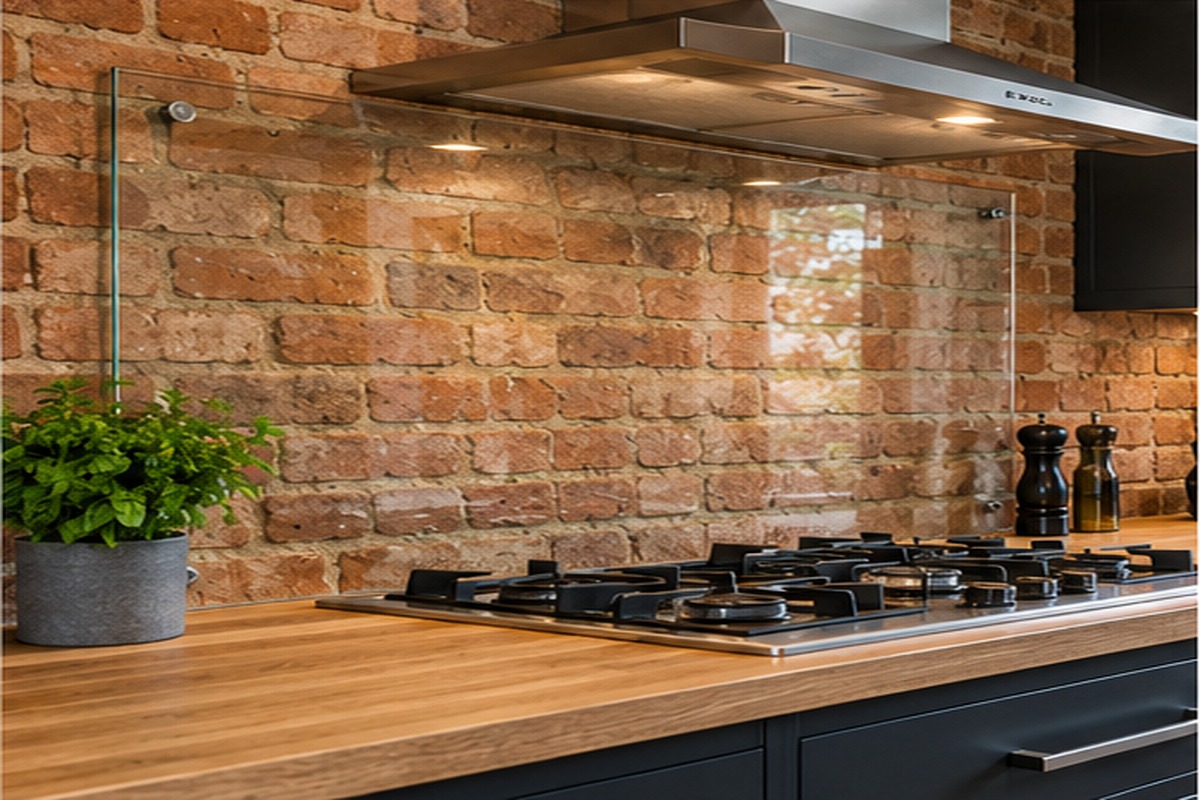
Not every kitchen improvement needs to introduce a new colour or decorative feature. Sometimes the most attractive part of a room is already there, whether it’s an exposed brick wall, carefully chosen wallpaper or a painted surface that complements the surrounding cabinets. The challenge is finding a way to protect these finishes from everyday cooking without covering them completely.
Kitchens are demanding environments for decorative walls. Grease, steam, water and food splashes can gradually affect surfaces, particularly around hobs and preparation areas. Even washable paints and specialist wall coverings may require frequent attention when exposed to regular cooking activities.
For homeowners who want to retain the appearance of their existing walls, clear glass splashbacks from Direct Splashbacks provide an interesting solution. The company supplies made-to-measure toughened glass, allowing customers to order protective panels designed around their kitchen’s dimensions. Rather than introducing an opaque colour, transparent glass allows the decorative surface behind it to remain visible.
When the Wall Is Already the Main Feature
Exposed brickwork has become a popular feature in kitchens, particularly in older properties and industrial-inspired interiors. Its uneven texture and natural colour variations can give a room considerable character.
However, brickwork isn’t always the easiest surface to maintain near a cooking area. Its porous nature and irregular joints can make removing grease and food residue more difficult than cleaning a smooth surface.
The same issue can arise with decorative wallpaper. A patterned wall may look attractive behind open shelving or along a worktop, but repeated exposure to cooking splashes can affect its appearance.
Covering these surfaces with conventional tiles or opaque panels would provide protection, but it would also conceal the very features that make them appealing.
Transparent glass offers an alternative. By creating a smooth protective barrier, it allows homeowners to preserve the visual character of the wall while making the exposed area easier to maintain.
This approach can be particularly effective when only part of the kitchen requires protection. A transparent panel behind the hob, for example, can be less visually intrusive than introducing a completely different material.
What Can Be Protected Behind Transparent Glass?
There are several situations where homeowners may prefer to retain an existing decorative finish rather than replace it.
| Existing wall finish | Why homeowners may want to retain it | What to consider |
|---|---|---|
| Exposed brickwork | Natural texture and traditional character | Uneven surfaces may require additional preparation and suitable fixing arrangements |
| Decorative wallpaper | Patterns and designs that complement the kitchen | The wallpaper should be securely attached and suitable for the proposed installation |
| Painted walls | Retains an established colour scheme | The paint should be fully cured and the surface properly prepared |
| Decorative plaster | Preserves a distinctive textured appearance | Wall irregularities may affect how the panel sits |
| Feature artwork or patterns | Keeps a personalised design visible | Positioning, reflections and the method of installation need consideration |
Although these applications can be attractive, the condition of the underlying surface matters. Transparent panels do not automatically make every decorative material suitable for use around a hob.
Particular care is needed with combustible materials, heat-sensitive finishes and surfaces that could trap moisture. The proposed installation should be checked against the glass supplier’s guidance and the cooking appliance manufacturer’s requirements.
Keeping the Kitchen’s Design Consistent
One of the less obvious advantages of transparent wall protection is that it can reduce the need to introduce additional materials into a kitchen.
Consider a room with painted green walls, natural oak worktops and cream cabinets. Adding a contrasting tiled splashback introduces another design element that needs to coordinate with the existing colours and textures.
Using clear glass allows the original wall colour to remain part of the design.
This can be particularly helpful in smaller kitchens, where several competing finishes may make the room appear busier than intended.
It is also worth considering kitchens that have recently been decorated. Homeowners may have spent considerable time choosing a particular paint colour or wallpaper pattern, only to discover that the area behind the hob needs additional protection.
Rather than changing the original design, clear glass splashbacks can help preserve its appearance while introducing a more practical surface for everyday cleaning.
Of course, glass isn’t completely invisible. Reflections, edges and fixing arrangements can still be noticeable, especially under strong lighting. Nevertheless, the overall effect is generally more restrained than covering the wall with an opaque material.
The Practical Benefits Become Clear During Cleaning
Cooking can be messy, even in a carefully maintained kitchen.
Frying food may leave small grease deposits on nearby walls. Sauces can splash during preparation, while steam and condensation are common around cooking equipment.
On a painted or textured surface, removing these marks may require additional care. Repeated scrubbing can affect certain decorative finishes, and porous materials may absorb some types of residue.
A glass panel provides a smooth, non-porous surface that can usually be wiped clean using a soft cloth and a suitable cleaning product.
There are no grout lines across the panel, which removes one of the areas where grease and dirt can accumulate on conventional tiled installations.
For busy households, this can make regular kitchen maintenance more straightforward.
However, transparent glass does require some attention to keep it looking its best. Fingerprints, watermarks and grease may be more visible under certain lighting conditions, particularly when viewed at an angle.
Using a suitable glass cleaner and a clean microfibre cloth can help maintain the surface without leaving excessive streaks.
The main advantage is that the decorative wall remains behind a protective surface rather than being directly exposed to everyday splashes.
Why Bespoke Measurements Matter
Transparent panels may appear relatively simple, but achieving a neat installation requires careful planning.
A poorly fitting panel can be particularly noticeable when the intention is to create a discreet protective surface. Uneven gaps, incorrect dimensions or badly positioned cut-outs can distract from the wall finish underneath.
This is one reason why made-to-measure clear glass splashbacks are worth considering.
Direct Splashbacks manufactures toughened glass panels according to the customer’s specified dimensions, making it possible to plan around individual kitchen layouts.
The position of wall cabinets, worktops, electrical sockets and other fittings will influence the measurements required.
Any openings must be accounted for before manufacturing, as toughened glass cannot be cut or drilled once the toughening process has been completed.
It is also important to consider how the glass will be fitted. Transparent panels can reveal certain adhesives or fixing arrangements, so the installation method needs to be appropriate for the intended appearance.
Direct Splashbacks provides measuring and installation guidance to help customers prepare their requirements before ordering.
Choosing the Right Glass for the Cooking Area
Ordinary glass and toughened glass are not interchangeable when it comes to kitchen installations.
Toughened glass is manufactured through a process that increases its strength and resistance to thermal stress. It is therefore commonly used for applications where standard glass would be unsuitable.
Direct Splashbacks supplies toughened glass products, including transparent options for customers who prefer an unobstructed view of the wall behind.
However, the suitability of any splashback depends on its intended position.
Gas hobs, electric hobs and induction appliances can have different installation requirements. The distance between the cooking equipment and the surrounding surfaces should always comply with the manufacturer’s instructions.
Homeowners should also consider the material behind the glass, particularly where wallpaper, timber or other potentially heat-sensitive finishes are involved.
A transparent protective panel should never be treated as permission to ignore the safety requirements of the underlying wall or cooking appliance.
Checking these details before ordering is an important part of planning a successful installation.
Ordering Without Visiting a Showroom
Made-to-measure products have traditionally been associated with visiting specialist suppliers, discussing dimensions and arranging quotations.
Online ordering provides another option for homeowners who already know what they need.
Direct Splashbacks allows customers to select their preferred glass, specify dimensions and obtain an instant quotation through its website.
This can be convenient when planning a relatively small kitchen improvement, particularly where the homeowner is replacing an existing splashback or adding protection to a newly decorated wall.
The company also offers free tracked delivery across mainland UK, which can help simplify the purchasing process.
Before placing an order, it is worth checking all measurements carefully and reviewing the available installation guidance.
For larger panels or more complicated layouts, professional assistance may be appropriate, particularly when handling heavy glass or working around electrical fittings.
The objective is to achieve a secure installation that protects the wall without compromising the appearance of the room.
A Different Approach to Kitchen Decoration
Kitchen design advice often concentrates on what can be added to a room: new colours, contrasting materials, decorative tiles or statement features.
Yet there are occasions when the better approach is to preserve what already works.
A carefully restored brick wall, a distinctive wallpaper pattern or an attractive painted finish may already provide the character a kitchen needs. Introducing another prominent surface could detract from that appearance rather than improve it.
Clear glass splashbacks offer a way to approach wall protection differently. Instead of making the splashback the main feature, the intention is to let the existing decoration remain visible.
For homeowners considering this option, Direct Splashbacks provides made-to-measure toughened glass and an online ordering process that accommodates individual dimensions.
The result can be a kitchen that retains its original character while gaining a practical surface where protection is needed most. Sometimes the most successful improvement is the one that allows the existing design to speak for itself.
Get in Touch:
Direct Splashbacks
United Kingdom
[email protected]
directsplashbacks.com